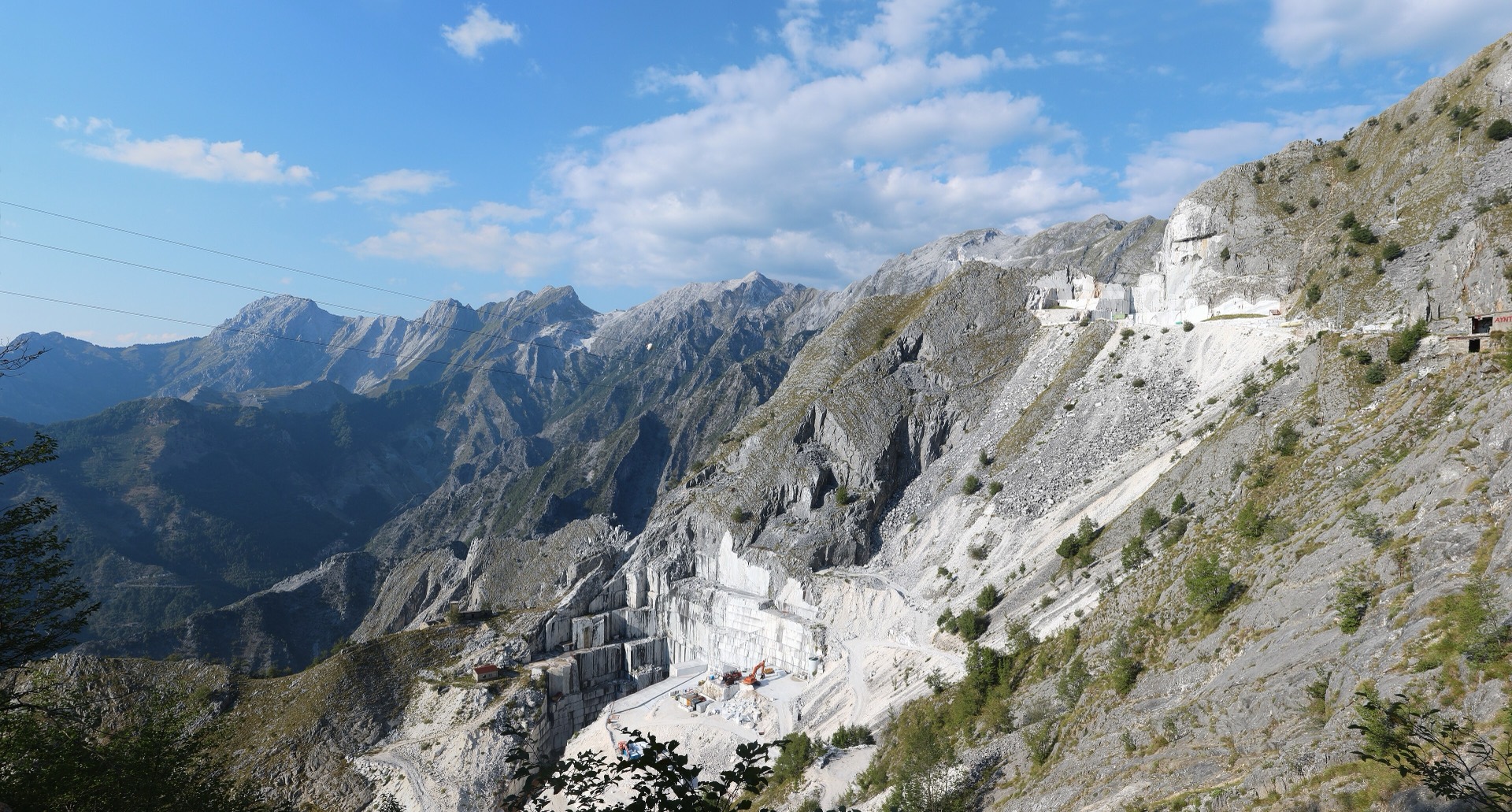
Marble is limestone that has been through something. Heat and pressure deep in the earth recrystallize the calcite or dolomite of an old seabed until the rock forgets it was sediment. The fossils blur out. The grain tightens into interlocking crystals that catch light a short distance below the surface before sending it back. That property, translucency, is why marble has read as flesh to carvers for three thousand years. It is also, in plain terms, why this material and not another sits at the center of the Western sculptural tradition.
1. How marble forms
The story starts as mud. Calcium carbonate accumulates on a sea floor, often from the shells and skeletons of small organisms, and compacts over a long time into limestone. Marble is what happens when that limestone is buried and subjected to the heat and directed pressure of mountain building, a process called regional metamorphism. The calcite crystals dissolve and regrow larger and interlocked. Impurities decide the color: pure calcite gives white, iron and other minerals give the grays, golds, greens, and rose tones, and the swirling veins are mineral impurities smeared by the same pressure that made the rock. The result is hard enough to hold a fine edge and soft enough, relative to granite, to be cut with hand tools by a patient person. That narrow window of workability is the whole reason a figurative tradition grew up around it.
2. The ancient quarries
The Greeks found the good stone early. Pentelic marble, from Mount Pentelicus near Athens, built the Parthenon and carried a faint iron content that weathers to a warm honey color. Parian marble, from the island of Paros, was the sculptor’s stone, prized for a deep translucency that made it the choice for free-standing figures. Naxos supplied a coarser, harder marble used earlier. By the classical period the link between this rock and the human figure was already fixed in the culture, not as a preference but as an assumption.
Rome industrialized it. Roman engineering opened large quarries and moved enormous blocks across the empire, and Roman taste, much of it copying Greek originals, kept the demand high. The most consequential opening was in the Apuan Alps of Tuscany, the marble that the modern world calls Carrara.
3. Carrara, Pietrasanta, and the Renaissance
The white marble of Carrara is the most famous sculptural stone on earth, and its fame is largely one man’s doing. Michelangelo went to the quarries himself, chose blocks at the source, and treated the selection of the stone as part of the work rather than a procurement step. The David is Carrara marble. So is the Pieta. His insistence that the figure was already in the block, and that carving was the act of removing what was not the figure, is a romantic description of a real method: direct carving, working the stone itself rather than mechanically copying a finished model.
The towns at the base of the Apuan Alps, Carrara and nearby Pietrasanta, became and remain a center of gravity for stone sculpture. Bernini, a century later, made Baroque marble do things that look impossible, drapery and motion and soft flesh in a brittle medium, mostly by abandoning strict direct carving for a studio system that used finished models and skilled assistants. Canova, later still, refined that system to a high polish. For roughly four centuries the mainstream of European marble sculpture ran through a model-and-pointing workflow, with direct carving as the older, harder, less forgiving alternative that never entirely went away.
4. The pointing machine
It is worth being precise about what the pointing machine is, because it explains the argument that comes later. It is a measuring device. It transfers specific three-dimensional points from a finished plaster or clay model onto a rough block so that carvers can remove stone with confidence, knowing exactly how deep to go before reaching the final surface. It made large-scale marble production reliable and teachable. It also moved the creative decision out of the stone and into the model. From the eighteenth century onward, a great deal of marble was, in effect, a high-craft reproduction of something the artist had already finished in clay.
5. American marble and the modern split
The United States had its own stone. Vermont produced large quantities of building and monumental marble. Colorado Yule marble, from a high quarry near Marble, Colorado, is a bright, even white used for the Lincoln Memorial and the Tomb of the Unknown Soldier. Georgia supplied a durable crystalline marble used widely in architecture. American sculpture leaned heavily on the Italian system, and many nineteenth-century American sculptors in fact worked in Italy, near the stone and the skilled carvers.
The twentieth century split the field. One direction was the revival of direct carving as a deliberate principle. Sculptors chose to abandon the model and the pointing machine and to work the stone itself, arguing that the resistance of the material and the irreversibility of the cut were not obstacles to the art but part of it. The other direction, late in the century, was mechanization: the pointing machine’s logic taken to its conclusion in computer scanning and CNC milling, where a digital model is cut into stone by a machine and finished by hand. Both still exist. A great deal of contemporary marble is milled. A smaller, deliberate practice still cuts by hand, on the conviction that how the thing is made is not separable from what it means.
6. Tine’s relationship to the stone
Michael Tine works on the hand-carving side of that split, and not as nostalgia. He carves figurative work directly, mostly in marble, with hammer and chisel, and for personal work without a fixed preparatory model, letting the form arrive through the act of cutting. The slowness is the method. The irreversibility is the point: a cut that cannot be taken back forces the decision to be real.
He works other stones for what each one is.
- Marble is the primary material and the reason, decades ago, that he came to Ventura at all.
- Travertine, a banded calcium carbonate formed at mineral springs, carries its own internal structure that a carver works with rather than against.
- Alabaster, soft and translucent, takes light differently and rewards a different touch than marble.
- Limestone and soapstone each behave differently again under the same tools, and part of the craft is knowing what a given block will and will not do at a given scale.
He prefers to work large, partly for a practical reason that connects directly to the nature of the stone: in a big block a broken corner is recoverable, with material still to go after, while in a small one a hidden crack or void can take the whole piece. The stone is not a neutral medium that receives an idea. It has a structure, a temper, and hidden faults, and the work is a negotiation with all of that, conducted by hand, one irreversible decision at a time.
That negotiation is the through-line of this entire history. From Paros to Carrara to a studio in Ventura, the constant is not a style. It is a particular relationship between a person, a chisel, and a rock that gives light back.
If you are considering a commissioned piece in marble or stone, see Commissions.